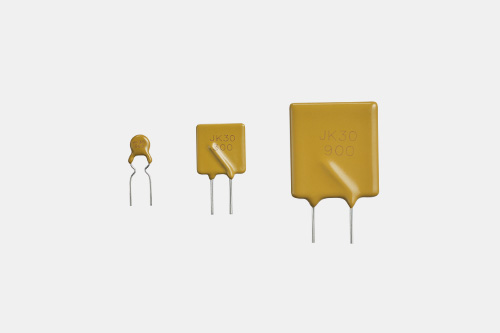

The self recovery fuse is composed of specially treated polymer resin and conductive particles (Carbon Black) distributed inside. Under normal operation, the polymer resin tightly binds conductive particles outside the crystalline structure, forming a chain like conductive electrical pathway. At this time, the recoverable fuse is in a low resistance state (a), and the heat generated by the current flowing through the self recovering fuse on the circuit is small and does not change the crystal structure. When a circuit experiences a short circuit or overload, the heat generated by the large current flowing through the self recovery fuse causes the polymer resin to melt, rapidly increase in volume, and form a high resistance state (b). The working current rapidly decreases, thereby limiting and protecting the circuit. After the fault is eliminated, PTC can restore the fuse to cool and crystallize again, shrink the volume, and the conductive particles form a conductive path again. The
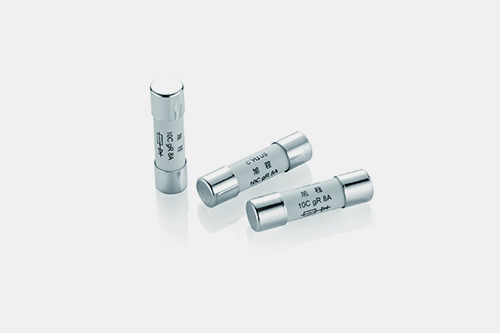
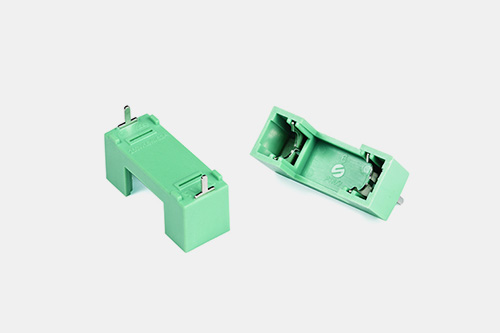
According to size, it can be divided into Dimensions, 3.6X10, 3X10, 5X20, 6X30, 6X32, 6X25, 10 * 38, 2.4X7, 2.5X6, 3X8, 2.5X9, 8.5X8, 8.5X8X4, 3.5X10, 3.5X9 According to current, it can be divided into 32ma, 63ma, 100mA, 150mA, 200mA, 250mA, 300mA, 400mA, 500mA, 600mA, 800mA, 1A, 1.25A, 1.6A, 2A, 2.5A, 3A, 3.5A, 4A, 5A, 6A, 7A, 8A, 9A, 10A, 12A, 15A, 20A, 25A, 30A According to material classification, it can be divided into Glass current fuse, ceramic current fuse
Rated voltage The nominal working voltage of a fuse, codenamed Un, is generally rated at 32V, 60V, 125V, 250V, 300V, 500V, 600V, and 1200V. Fuses can be used at a voltage not exceeding their rated voltage, but are generally not approved for use in circuits with a circuit voltage greater than the rated voltage of the fuse. Voltage drop When the rated current is applied to the fuse, the voltage measured at both ends of the fuse when the fuse reaches Thermal equilibrium, that is, when the temperature is stabilized, is Ud. Due to the voltage drop at both ends of the fuse having a certain impact on the circuit, there are clear provisions for voltage drop in European regulations. Fuse resistance Usually divided into cold resistance and hot resistance, cold resistance is the resistance value measured by a test current less than 10% of the rated current at a fuse temperature of 25 ℃. The thermal resistance is converted from the voltage drop measured at the full rated current value as
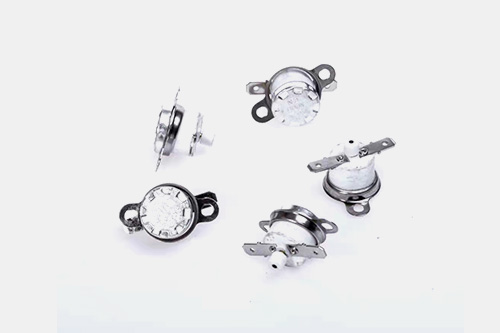
Precautions for installation of Thermal cutoff: 1. When the lead wire is bent for use, it should be bent from the part more than 6mm away from the root; When bending, it is not allowed to damage the roots and leads, and it is not allowed to forcefully pull, press, or twist the leads. 2. When the thermal fuse is fixed by screws, riveting, or wiring terminals, it should be able to prevent mechanical creep and the occurrence of poor contact. 3. The connecting components should be able to work reliably within the working range of the electrical product, without displacement due to vibration and impact. When conducting wire welding operations, the heating humidity should be limited to the minimum, and attention should be paid not to apply high temperatures to the thermal fuse; Do not forcefully pull, press, or twist the thermal fuse and leads; After welding, it should be immediately cooled for more than 30 seconds. 5. The thermal fuse can only be used under the specified rated voltage,
Precautions for installation of SEFUSE Thermal cutoff: 1. When the lead wire is bent for use, it should be bent from the part more than 6mm from the root; When bending, it is not allowed to damage the roots and leads, and it is not allowed to forcefully pull, press, or twist the leads. 2. When the thermal fuse is fixed by screws, riveting, or wiring terminals, it should be able to prevent mechanical creep and the occurrence of poor contact. 3. The connecting components should be able to work reliably within the working range of the electrical product, without displacement due to vibration and impact. When conducting wire welding operations, the heating humidity should be limited to the minimum, and attention should be paid not to apply high temperatures to the thermal fuse; Do not forcefully pull, press, or twist the thermal fuse and leads; After welding, it should be immediately cooled for more than 30 seconds. 5. The thermal fuse can only be used under the specified rated voltage
According to temperature, it can be divided into: 73 degrees 99 degrees 77 degrees 94 degrees 113 degrees 121 degrees 133 degrees 142 degrees 157 degrees 172 degrees 192 degrees 216 degrees 227 degrees 240 degrees 70 degrees 77 degrees 84 degrees 92 degrees 95 degrees 105 degrees 110 degrees 115 degrees 121 degrees 128 degrees 130 degrees 139 degrees 141 degrees 144 degrees 152 degrees 157 degrees 169 degrees 184 degrees 185 degrees 192 degrees 216 degrees 227 degrees 228 degrees 240 degrees 250 degrees 280 degrees 320 degrees Due to the certain overload capacity of various electrical equipment, it is allowed to operate for a long time under certain conditions; When the load exceeds the allowable value, it is required to protect the melt from melting within a certain period of time. Some devices have a high starting current but a short starting time, so it is required that the protective characteristics of these devices should meet the needs of equipment operation. It is required

MB:+86 13924633629 Ms.vicky
E-mail: waimao@xcfuse.com
Factory :
XC Electronics(Shenzhen)Corp.,LTD
Add: Xucheng Technology Park, Daling Street Industrial Park, Huidong County, Huizhou City, Guangdong Province
Shenzhen branch: Shenzhen Xucheng Electronic Commerce co.Ltd
Add: 17A,Bldg 1,Innovation Industrial Park, No. 1 Danqing RD, Jinsha, Kengzi, Pingshan DIST, Shenzhen,Guangdong 518122 China